
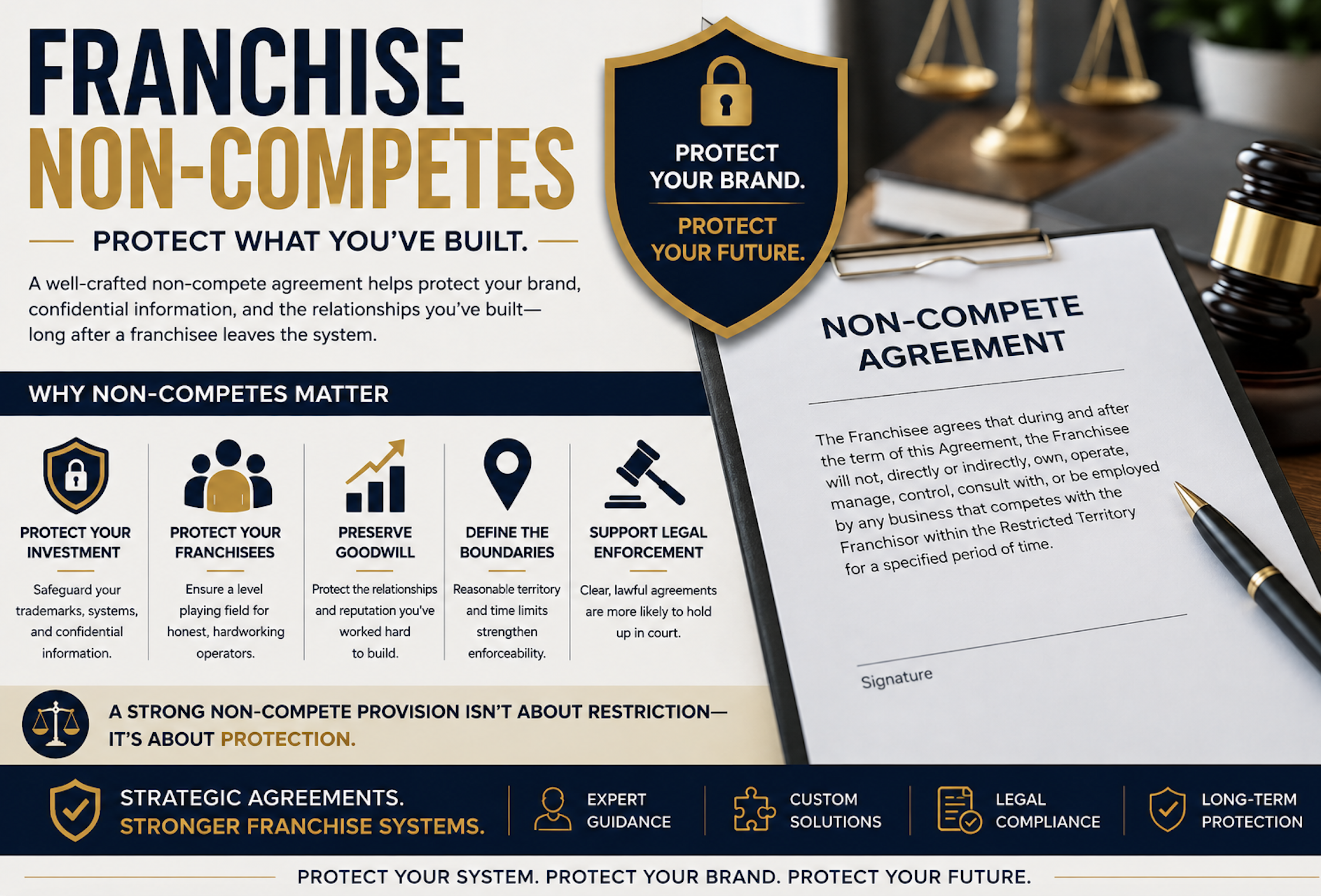
When you franchise your business model, one the most significant concerns is how to protect your intellectual property and defend your business model as you scale. Below is a practical franchise risk assessment for the enforceability of post-term non-compete covenants against franchisees. This is not a legal ranking, but rather a practical assessment based on current statutes, court decisions, and public policy. The law in this area changes frequently, and courts often distinguish franchise non-competes from employment non-competes because franchisees receive confidential information, trademarks, goodwill, and system know-how.
Enforceability Scale
- 5 = Generally favorable to enforcement if reasonable in scope, duration, and geography.
- 4 = Generally enforceable, but courts scrutinize reasonableness.
- 3 = Mixed; enforceability depends heavily on facts and drafting.
- 2 = Difficult; restrictive statutes or strong judicial scrutiny.
- 1 = Very difficult; significant statutory or public-policy barriers.
| State | Rating | Comments |
|---|---|---|
| Alabama | 4 | Generally enforces reasonable franchise covenants. |
| Alaska | 3 | Moderate scrutiny; reasonable restrictions may be enforced. |
| Arizona | 4 | Generally favorable if narrowly tailored. |
| Arkansas | 4 | Enforceable with legitimate business interest. |
| California | 1 | Post-term non-competes are generally void, with limited statutory exceptions (e.g., sale of business). Franchise-specific restrictions face significant hurdles. |
| Colorado | 2 | Recent statutory changes greatly restrict non-competes; franchise covenants require careful analysis. |
| Connecticut | 4 | Generally enforceable if reasonable. |
| Delaware | 5 | Business-friendly; courts routinely enforce reasonable franchise covenants. |
| Florida | 5 | One of the strongest states for enforcing reasonable restrictive covenants under § 542.335, Fla. Stat. |
| Georgia | 5 | Favorable after 2011 constitutional/statutory reforms. |
| Hawaii | 3 | Moderate scrutiny. |
| Idaho | 4 | Generally enforceable if reasonable. |
| Illinois | 3 | Increased scrutiny; franchise agreements differ from employment agreements, but careful drafting is important. |
| Indiana | 4 | Generally favorable. |
| Iowa | 4 | Courts enforce reasonable restrictions. |
| Kansas | 4 | Business-friendly. |
| Kentucky | 4 | Generally enforceable. |
| Louisiana | 2 | Statutory requirements are strict, including geographic specificity. |
| Maine | 3 | Moderate scrutiny. |
| Maryland | 3 | Greater scrutiny in recent years; franchise context still recognized. |
| Massachusetts | 3 | Employment law changed substantially; franchise restrictions remain possible but require careful drafting. |
| Michigan | 5 | Generally favorable for commercial agreements. |
| Minnesota | 2 | Recent legislation bans many employment non-competes; franchise agreements are analyzed separately but courts may scrutinize restrictions. |
| Mississippi | 5 | Strong enforcement history. |
| Missouri | 4 | Generally favorable. |
| Montana | 2 | Restrictive approach. |
| Nebraska | 3 | Moderate enforcement. |
| Nevada | 4 | Generally favorable if reasonable. |
| New Hampshire | 3 | Moderate scrutiny. |
| New Jersey | 4 | Generally enforces reasonable franchise restrictions. |
| New Mexico | 2 | Restrictive statutory environment. |
| New York | 4 | Courts routinely enforce reasonable franchise covenants protecting goodwill and confidential information. |
| North Carolina | 4 | Well-developed law supporting reasonable restrictions. |
| North Dakota | 1 | Statute generally prohibits non-competes, with limited exceptions. |
| Ohio | 5 | Strong history of enforcement in commercial settings. |
| Oklahoma | 2 | Significant statutory restrictions. |
| Oregon | 3 | Employment non-compete reforms have increased scrutiny; franchise agreements may still be enforceable depending on the circumstances. |
| Pennsylvania | 4 | Generally favorable. |
| Rhode Island | 3 | Moderate scrutiny. |
| South Carolina | 4 | Enforceable if narrowly drafted. |
| South Dakota | 3 | Moderate enforcement. |
| Tennessee | 4 | Generally favorable. |
| Texas | 5 | One of the most favorable states for enforcing reasonable franchise non-competes. |
| Utah | 4 | Generally favorable in commercial settings. |
| Vermont | 2 | Restrictive public policy. |
| Virginia | 3 | Increased scrutiny, particularly after employment law reforms. |
| Washington | 2 | Recent legislation significantly restricts non-competes; franchise agreements require careful analysis. |
| West Virginia | 4 | Generally favorable. |
| Wisconsin | 3 | Strict judicial review; overbroad restrictions are often invalidated rather than rewritten. |
| Wyoming | 4 | Generally favorable. |
Overall Categories
Most Favorable (5)
- Delaware
- Florida
- Georgia
- Michigan
- Mississippi
- Ohio
- Texas
These states generally recognize a franchisor’s legitimate interests in protecting goodwill, confidential information, operating systems, and trademarks, provided the restrictions are reasonable.
Generally Favorable (4)
- Alabama
- Arizona
- Arkansas
- Connecticut
- Idaho
- Indiana
- Iowa
- Kansas
- Kentucky
- Missouri
- Nevada
- New Jersey
- New York
- North Carolina
- Pennsylvania
- South Carolina
- Tennessee
- Utah
- West Virginia
- Wyoming
Mixed (3)
- Alaska
- Hawaii
- Illinois
- Maine
- Maryland
- Massachusetts
- Nebraska
- New Hampshire
- Oregon
- Rhode Island
- South Dakota
- Virginia
- Wisconsin
Difficult (2)
- Colorado
- Louisiana
- Minnesota
- Montana
- New Mexico
- Oklahoma
- Vermont
- Washington
Most Difficult (1)
- California
- North Dakota
Best Practices for Franchisors
Regardless of the state, franchise non-competes are more likely to be enforced when they:
- Last one to two years after termination.
- Cover only the geographic area where the franchise operated or had meaningful market presence.
- Protect legitimate business interests such as confidential information, customer goodwill, operating systems, and trademarks.
- Are paired with strong confidentiality, non-solicitation, and trademark-protection provisions.
- Include a blue-pencil or judicial modification clause where permitted, allowing a court to narrow an overbroad restriction rather than invalidate it entirely. You do risk the entire enforceability of your agreement and non-compete if you make your distance too broad or overreaching.
- Are drafted with the governing state’s law in mind and reviewed periodically as state statutes and case law evolve.
For more information on how to Franchise Your Business, contact Franchise Marketing Systems: www.FMSFranchise.com

