
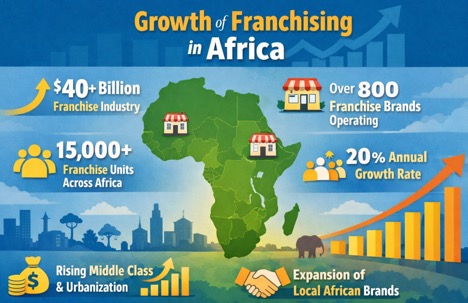
Franchising in Africa represents one of the most exciting frontiers for business expansion in the global economy. With a population exceeding 1.4 billion people, rapid urbanization, a growing middle class, and increasing demand for structured business systems, Africa offers immense opportunity for brands looking to scale. However, franchising across Africa is not a simple “copy-and-paste” of Western models—it requires careful planning, localization, legal structuring, and strategic execution.
This article provides a comprehensive 1,700-word overview of how to franchise a business in Africa and the step-by-step process of developing a scalable franchise system across multiple African markets.
The Opportunity for Franchising in Africa
Franchising is increasingly viewed as a powerful engine for economic development across Africa. According to the African Export-Import Bank, franchising is a “critical instrument” for unlocking opportunities for small and medium-sized enterprises (SMEs) and driving intra-African trade.
Despite this potential, franchising is still underdeveloped across much of the continent. Outside of more mature markets such as South Africa, Nigeria, and parts of North Africa, franchise systems remain fragmented and in early stages of development.
This gap represents a significant opportunity:
- Limited competition in many sectors
- High demand for structured, proven business models
- Strong interest from entrepreneurs seeking established brands
At the same time, challenges such as inconsistent legal systems, financing limitations, and cultural diversity require a strategic and informed approach.
Understanding the African Franchising Landscape
Before developing a franchise system in Africa, it is critical to understand the structural realities of the continent.
1. A Fragmented Market
Africa consists of 55 countries, each with its own:
- Legal system
- Language (English, French, Arabic, Portuguese)
- Regulatory environment
- Economic conditions
This fragmentation means there is no “single Africa strategy.” Each country must be evaluated individually.
2. Varying Legal Frameworks
Unlike the United States, Africa does not have a unified franchise regulatory system. In many countries:
- There is no single franchise law
- Franchising is governed by general commercial law, contract law, and consumer protection regulations
Some regions, such as OHADA (covering 17 West and Central African countries), have harmonized business laws to improve investment conditions.
In more developed markets like South Africa:
- Franchise relationships are regulated under the Consumer Protection Act (CPA)
- Disclosure requirements and franchise agreements are mandatory
3. Emerging Franchise Models
Africa has a mix of franchising structures, including:
- Business format franchising (most common)
- Product distribution franchising
- Micro-franchising (especially in emerging markets)
Micro-franchising, in particular, plays a significant role in lower-income markets by enabling small entrepreneurs to operate simplified franchise models.
Step-by-Step: How to Franchise a Business in Africa
Developing a franchise system in Africa requires a structured, phased approach. Below is a step-by-step framework used by successful franchise brands.
Step 1: Validate Your Business Model
Before franchising in Africa, your business must be:
- Profitable
- Replicable
- Scalable
Key questions:
- Can the model work in different economic environments?
- Is it adaptable to local supply chains and labor markets?
- Does it require heavy infrastructure or capital?
In Africa, simplicity is critical. Concepts that succeed typically:
- Have low startup costs
- Are labor-efficient
- Solve everyday consumer needs
Step 2: Conduct Market Entry Analysis
Africa is not one market—it is many. Successful franchisors prioritize specific countries based on:
Key Factors:
- GDP growth and economic stability
- Urban population density
- Ease of doing business
- Legal framework
- Competitive landscape
Top Entry Markets Often Include:
- South Africa (most developed franchise ecosystem)
- Nigeria (large population, strong consumer demand)
- Kenya (gateway to East Africa)
- Ghana (stable West African market)
- Morocco and Egypt (North African hubs)
This market selection phase determines your expansion strategy.
Step 3: Protect Your Intellectual Property
Before entering any African market, brand protection is essential.
Key Actions:
- Register trademarks in each country
- Use regional IP organizations:
- ARIPO (English-speaking countries)
- OAPI (French-speaking countries)
- Protect:
- Brand name
- Logos
- Operating systems
- Training materials
Without proper IP protection, your brand is vulnerable to replication and misuse.
Step 4: Develop Franchise Documentation
A professional franchise system requires legally sound and operationally complete documentation.
Core Documents:
1. Franchise Disclosure Document (FDD)
Provides transparency and includes:
- Company history
- Financial performance
- Fees and costs
- Franchisee obligations
Disclosure is mandatory in some African markets and best practice in all.
2. Franchise Agreement
Defines the legal relationship between franchisor and franchisee, including:
- Territory rights
- Fees and royalties
- Operational standards
- Term and renewal
- Exit and termination
3. Operations Manual
The backbone of the franchise system:
- Daily operations
- Customer service standards
- Marketing processes
- Training procedures
4. Training Programs
Adapted for local markets:
- Language considerations
- Cultural nuances
- Skill levels
Strong documentation creates consistency and scalability across borders.
Step 5: Choose the Right Expansion Model
Franchising in Africa often requires flexible structures due to market diversity.
Common Expansion Models:
1. Master Franchise Model
- One partner controls an entire country or region
- Responsible for sub-franchising
Best for: Rapid expansion with local expertise
2. Area Developer Model
- Partner develops multiple locations
- No sub-franchising rights
3. Joint Venture Model
- Franchisor partners with a local operator
- Shared ownership and control
4. Direct Franchising
- Franchisor sells units directly to franchisees
Best for: Smaller, more controlled markets
In Africa, the master franchise model is often preferred due to the need for strong local knowledge and infrastructure.
Step 6: Build Local Partnerships
Local partnerships are critical to success in Africa.
Why They Matter:
- Navigate regulatory environments
- Understand cultural dynamics
- Access supply chains
- Build local credibility
According to franchise experts, success in Africa often depends heavily on the quality of the master franchisee.
Step 7: Adapt the Business Model to Local Markets
Localization is one of the most important steps in African franchising.
Areas to Adapt:
- Pricing strategies
- Product or service offerings
- Marketing messaging
- Payment systems (mobile money is dominant in many markets)
At the same time, it is critical to maintain brand consistency.
Balancing standardization and localization is key to long-term success.
Step 8: Develop Supply Chain and Infrastructure
Supply chain challenges are one of the biggest barriers in Africa.
Considerations:
- Import vs. local sourcing
- Logistics and transportation
- Infrastructure limitations
Successful franchisors often:
- Develop regional distribution hubs
- Identify local suppliers
- Simplify product offerings
Step 9: Establish Training and Support Systems
Franchise success depends on ongoing support.
Key Support Systems:
- Initial training programs
- Field support teams
- Marketing assistance
- Technology platforms
Operational systems must be adapted to reflect local conditions while maintaining global standards.
Step 10: Launch Pilot Locations
Before scaling, it is critical to test the model.
Pilot Objectives:
- Validate unit economics
- Test operational systems
- Identify challenges
Pilot locations provide real-world data that informs expansion strategy.
Step 11: Scale Across Regions
Once validated, expansion can begin.
Scaling Strategy:
- Expand within initial country
- Move into neighboring markets
- Leverage regional trade agreements
A strong legal and operational foundation makes cross-border growth more efficient.
Challenges in Franchising Across Africa
While the opportunity is significant, franchising in Africa presents unique challenges:
1. Legal and Regulatory Complexity
Different countries have different laws, requiring customized legal strategies.
2. Financing Constraints
Access to capital is limited in many markets, making franchise funding a challenge.
3. Infrastructure Limitations
Logistics, utilities, and transportation can impact operations.
4. Skills and Training Gaps
Workforce development is essential for franchise success.
5. Cultural Diversity
Business practices vary widely across regions.
Best Practices for Building a Pan-African Franchise System
To succeed in Africa, franchisors should follow these best practices:
1. Start with Strong Markets
Focus on 1–2 key countries before expanding further.
2. Use Master Franchisees Strategically
Leverage local expertise for faster growth.
3. Invest in Training
Build strong operational capabilities at the local level.
4. Prioritize Simplicity
Complex models are harder to scale in emerging markets.
5. Focus on Unit Economics
Ensure franchisees can achieve profitability quickly.
The Future of Franchising in Africa
Franchising is poised to play a major role in Africa’s economic development.
Key trends include:
- Growth of homegrown African franchise brands
- Increased international franchise entry
- Expansion of micro-franchising models
- Greater regulatory development
As awareness of franchising increases and infrastructure improves, the sector is expected to grow significantly across the continent.
Franchising a business in Africa offers tremendous opportunity—but it requires a thoughtful, localized, and strategic approach. Unlike more mature markets, Africa demands flexibility, cultural awareness, and strong partnerships.
The process of developing a franchise system across Africa involves:
- Validating the business model
- Selecting target markets
- Protecting intellectual property
- Building legal and operational infrastructure
- Establishing local partnerships
- Testing and scaling the model
While challenges such as legal complexity, financing, and infrastructure exist, they are outweighed by the long-term growth potential.
For franchisors willing to invest in the process and adapt to the unique dynamics of the continent, Africa represents one of the most exciting and underdeveloped franchise markets in the world—offering the potential to build scalable, impactful, and highly profitable franchise systems.
For more information on how to franchise your business in Africa, contact FMS Franchise Africa.
 Franchise Marketing Systems