
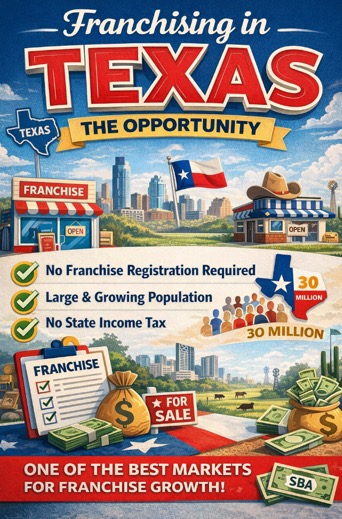
Texas is one of the most business-friendly states in the country and one of the largest economies in the world. With a population of more than 30 million people, no state income tax, strong population growth, and a pro-business regulatory environment, Texas represents one of the most attractive markets for franchise expansion in the United States.
One of the most appealing aspects of franchising in Texas is that Texas is not a franchise registration state. This distinction significantly impacts the speed, cost, and complexity of launching and growing a franchise brand within the state.
Learn more about the process of Texas Franchise Registration: https://thefranchisecourier.com/texas-franchise-registration/
In this article, we’ll explore:
- Whether Texas requires franchise registration
- The legal process for offering franchises in Texas
- How Texas compares to registration states
- Key compliance steps
- The business opportunity and market dynamics in Texas
Is Texas a Franchise Registration State?
No.
Texas is not a franchise registration state. This means that franchisors do not need to register their Franchise Disclosure Document (FDD) with a state regulatory agency before offering or selling franchises in Texas.
This is a major advantage compared to states like:
- California
- New York
- Illinois
- Maryland
- Washington
- Minnesota
- Virginia
- Indiana
- Wisconsin
- Michigan
- North Dakota
- Rhode Island
- Hawaii
In those states, franchisors must file their FDD with a state regulator, undergo review, respond to comments, and receive approval before selling franchises.
In Texas, there is no such pre-sale registration requirement.
For a overview on the franchise registration states: https://www.fmsfranchise.com/learn/resources/state-guidelines/
What Is Required to Offer Franchises in Texas?
Even though Texas does not require franchise registration, franchisors must still comply with federal franchise law under the Federal Trade Commission (FTC) Franchise Rule.
This means:
- The franchisor must prepare a compliant Franchise Disclosure Document (FDD).
- The FDD must contain all 23 required disclosure items.
- The FDD must be provided to a prospective franchisee at least 14 days before signing any agreement or accepting payment.
So while Texas simplifies the process, it does not eliminate legal obligations.
The Step-by-Step Process to Offer Franchises in Texas
Step 1: Develop the Franchise Model
Before any legal documentation is created, the franchisor should:
- Finalize the business model
- Develop operating systems
- Document brand standards
- Build training programs
- Create operations manuals
- Define territory structures
- Establish financial performance metrics
Franchising is about replicable systems. The stronger the foundation, the smoother the expansion.
Step 2: Form the Legal Entity
Most franchisors form:
- A corporation (Inc.) or
- A limited liability company (LLC)
The entity should be properly structured with:
- Clear ownership
- Defined management
- Proper capitalization
Texas does not require the franchisor entity to be formed in Texas specifically, but many brands expanding heavily in the state choose to register as a foreign entity doing business in Texas if operating locally.
Step 3: Prepare the Franchise Disclosure Document (FDD)
The FDD is the cornerstone of franchise compliance.
It includes:
- Company background
- Litigation history
- Bankruptcy disclosures
- Franchise fees
- Estimated initial investment
- Ongoing royalty and advertising fees
- Franchisee obligations
- Territory rights
- Training and support structure
- Financial statements
The FDD must be updated annually and whenever there are material changes.
Even though Texas does not require state filing, the FDD must comply with federal law.
Step 4: Provide the FDD to Prospective Franchisees
Before signing a Franchise Agreement or accepting money:
- The FDD must be delivered at least 14 calendar days in advance.
- Any final agreement must reflect what was disclosed.
Failure to follow disclosure timing rules can result in rescission claims or legal exposure.
Step 5: Franchise Agreement Execution
Once disclosure timing requirements are met:
- The franchisee signs the Franchise Agreement.
- The initial franchise fee is paid.
- Training and onboarding begin.
No state approval is required in Texas before executing the agreement.
Why Texas Is Attractive for Franchisors
Texas offers several unique advantages that make it one of the strongest franchise growth markets in the U.S.
1. Large and Growing Population
Texas has:
- Over 30 million residents
- Several metropolitan areas with populations over 1 million
- Rapid migration from California, New York, Illinois, and other high-tax states
Major markets include:
- Dallas–Fort Worth
- Houston
- Austin
- San Antonio
Population growth fuels demand for:
- Restaurants
- Service franchises
- Health and wellness brands
- Home services
- Child services
- Fitness concepts
Growth creates opportunity for both emerging and established brands.
2. No State Income Tax
Texas does not impose a state income tax on individuals.
For franchisees, this means:
- Higher net take-home income
- Attractive economics compared to high-tax states
- Increased appeal for entrepreneurs relocating to Texas
This often strengthens franchise recruitment in the state.
3. Pro-Business Regulatory Environment
Texas is known for:
- Reasonable business regulations
- Faster permitting compared to some states
- Support for entrepreneurship
- Strong small business ecosystem
This environment supports franchise expansion.
4. Strong Economic Diversity
Texas is not dependent on one industry.
Major sectors include:
- Energy
- Technology
- Healthcare
- Logistics
- Manufacturing
- Real estate
- Professional services
This economic diversity creates stable demand across multiple franchise categories.
Texas vs. Registration States: A Strategic Advantage
In registration states, franchisors must:
- File the FDD
- Pay state filing fees (often $500–$750 per state)
- Respond to regulator comments
- Wait weeks or months for approval
In Texas:
- No filing required
- No review process
- No state approval delays
- Lower compliance cost
- Faster market entry
For emerging brands, this is a major advantage.
Many new franchisors choose to begin expansion in non-registration states like Texas to build validation and system strength before entering more heavily regulated states.
What Texas Does Regulate
While Texas does not require franchise registration, it does enforce:
- General business laws
- Deceptive Trade Practices Act (DTPA)
- Contract law
- Employment laws
- Licensing requirements (where applicable)
Franchisors must still operate transparently and ethically.
Additionally, Texas does regulate business opportunity sellers, but most compliant franchise systems are exempt because they provide an FDD in accordance with federal law.
Opportunities for Different Franchise Categories in Texas
Texas offers strong potential across multiple industries.
Restaurant & QSR
High population density in urban markets supports:
- Fast casual
- Ethnic concepts
- Coffee brands
- Drive-thru models
Texas consumers are receptive to new food brands.
Home Services
Rapid suburban expansion fuels demand for:
- HVAC
- Lawn care
- Pest control
- Plumbing
- Cleaning services
New housing developments create recurring service opportunities.
Health & Fitness
Austin, Dallas, and Houston are strong markets for:
- Boutique fitness
- Wellness studios
- Personal training concepts
Child & Education Services
Family migration into suburban markets drives:
- Tutoring
- Early education
- Enrichment programs
Automotive & Mobile Services
Car culture and urban sprawl create opportunities for:
- Auto repair
- Mobile detailing
- Service-based mobile brands
Key Considerations for Franchisors Expanding in Texas
While Texas is attractive, strategy still matters.
1. Territory Planning
Major metro areas are competitive. Proper:
- Territory mapping
- Population density analysis
- Household income evaluation
is critical.
2. Brand Differentiation
Texas markets are franchise-heavy. Standing out requires:
- Clear value proposition
- Strong marketing support
- Competitive pricing model
3. Real Estate Strategy
Retail rents vary significantly:
- Dallas and Austin can be expensive
- Secondary markets offer lower entry cost
Smart site selection directly impacts performance.
The Long-Term Opportunity
Texas continues to lead the country in:
- Population growth
- Corporate relocations
- Job creation
- Housing development
These factors create sustained demand for franchise brands.
For franchisors, Texas provides:
- Lower regulatory friction
- Large addressable market
- Strong entrepreneur base
- Favorable tax climate
For franchisees, Texas offers:
- Lower tax burden
- Economic opportunity
- Expanding consumer base
- Strong local business culture
Texas does not require franchise registration, making it one of the most accessible and attractive states for franchise expansion. While franchisors must comply with federal disclosure laws under the FTC Franchise Rule, they do not face the added complexity and delay of state-level FDD review and approval.
This streamlined regulatory environment, combined with explosive population growth, a strong economy, and a pro-business climate, makes Texas one of the premier franchise markets in the United States.
For emerging brands, Texas is often the ideal launch state. For established systems, it represents one of the largest expansion opportunities available.
In franchising, market selection matters. And from both a regulatory and economic standpoint, Texas stands out as one of the strongest opportunities in the country.
For more information on how to Franchise Your Business in Texas, connect with Franchise Marketing Systems: https://www.fmsfranchise.com/
 Franchise Marketing Systems